Which Stand Mixer Attachment Is Best for Buttercream: Whisk, Paddle, or Beater?
You’ll usually want the paddle for classic American and most Swiss buttercreams because it builds smooth, sturdy body without overwhipping. Use the whisk when you want ultra‑light, airy Swiss or Italian meringue buttercream—its aeration gives a delicate, fluffy texture. Reach for the beater if you need a dense, butter‑heavy frosting with minimal air for extra stability. Keep your choice aligned with texture and piping needs, and keep going to learn practical tips and tweaks.
How to Use This Guide: Pick by Frosting & Goal
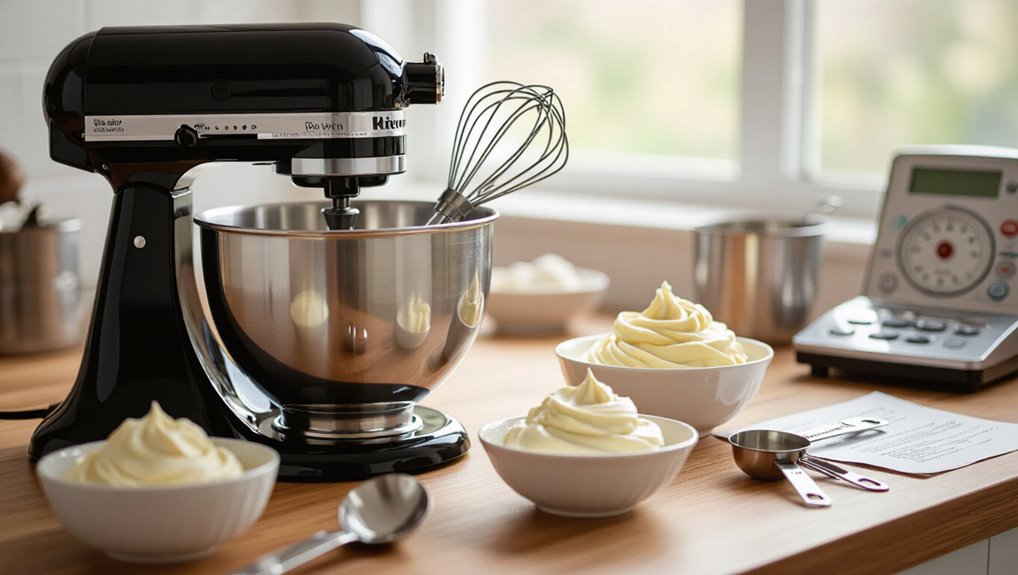
Wondering which attachment will give you the smoothest buttercream or the lightest Swiss meringue?
Use this guide by matching frosting type and end goal: choose attachments based on texture, speed, and aeration needs.
Match your frosting and finish: pick attachments by texture, speed, and aeration to get the result you want.
Scan the quick comparison, note recommended settings, and pick the tool that fits your recipe and desired finish.
Practice a batch to confirm results.
Quick Answer: Which Attachment Works Best for Buttercream
Which attachment works best depends on the buttercream you want: use the paddle for classic American buttercream and most Swiss buttercreams to get a smooth, stable texture without excess air.
Switch to the whisk when you want an ultra-light, airy Swiss or Italian meringue-based buttercream, and reach for the dough hook only for heavy, butter-heavy frostings that need thorough incorporation rather than aeration.
Use paddle for stability.
Three-Step Decision Flow: Pick the Right Attachment
How do you pick the right attachment quickly? Use this three-step flow to decide and get consistent buttercream.
- Assess texture goal: light and airy, smooth, or sturdy.
- Check bowl contents: small egg-white volumes favor whisk; dense butter mixes favor paddle.
- Match speed and time: faster whisking for aeration, steady paddle for emulsifying, slower beater for firm structure.
How Attachments Alter Buttercream Mixing Action
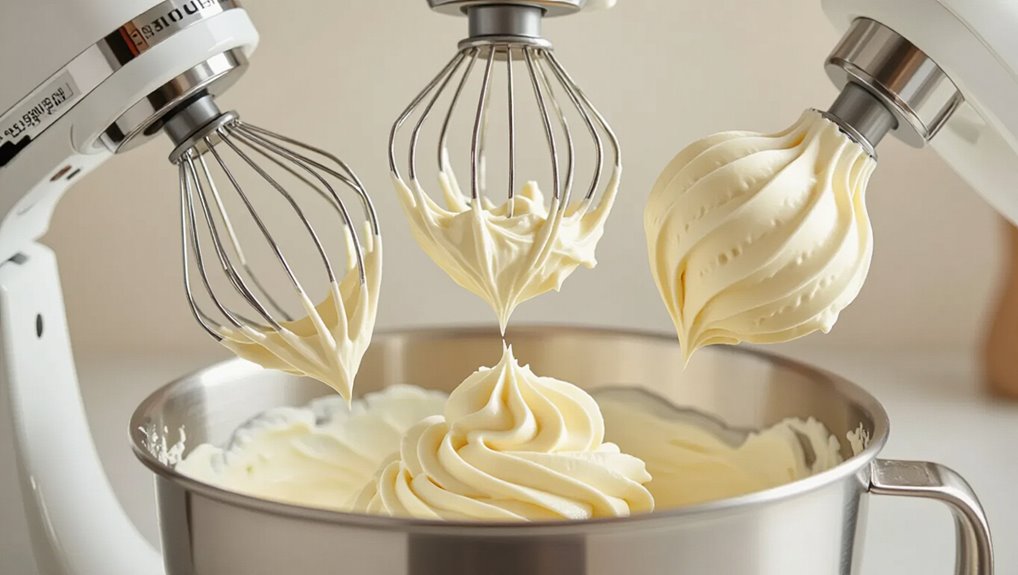
Because each attachment moves and cuts through ingredients differently, you’ll get distinct buttercream outcomes depending on the tool you choose. You’ll notice differences in aeration, creaminess, and speed: whisk adds air, paddle smooths, beater blends firmly. Match texture to purpose and adjust technique accordingly.
| Attachment | Action | Result |
|---|---|---|
| Whisk | Aerates | Light |
| Paddle | Shears | Smooth |
| Beater | Blends | Dense |
How Mixing Speed Affects Buttercream Texture
Speed matters: when you crank up the mixer, you trap more air and make buttercream lighter and fluffier, while slower speeds produce a denser, silkier finish.
Speed matters: higher mixer speeds trap air for light, fluffy buttercream; slower speeds yield a denser, silkier finish.
- Start slow to combine without splashing.
- Increase speed to aerate for volume.
- Slow again to refine texture and remove excess air.
You’ll judge speed by look and feel, stopping when texture suits your use.
How Ingredient Temperature Changes Attachment Performance
Get your butter to room temperature and you’ll let the paddle or whisk create smooth, aerated buttercream more easily.
If your butter or eggs are cold, they’ll resist aeration and the attachment won’t trap as much air.
Conversely, overly warm ingredients will blend faster but can make the frosting soft and harder to stabilize.
Room-Temperature Butter Benefits
When butter’s softened to room temperature, it creams more evenly and traps air more efficiently, so your paddle attachment produces a lighter, fluffier buttercream than a whisk or dough hook would.
You’ll notice these benefits:
- Easier spreading and smoother texture.
- Faster emulsification with sugar and liquids.
- Consistent volume and stable peaks for piping.
Cold Ingredients Limit Aeration
If room-temperature butter helps your paddle whip in lots of air, cold ingredients do the opposite: they slow creaming and keep the paddle from incorporating enough air.
You’ll notice denser, heavier buttercream and longer mixing times. Cold butter and chilled liquids stiffen the fat, reducing aeration no matter which attachment you use.
Let ingredients soften slightly for better volume and texture.
Warm Ingredients Speed Incorporation
Although warmer butter and liquids soften more readily, they let your paddle whip and whisk work much faster and with less effort. You’ll notice faster blending, smoother texture, and fewer lumps.
Adjust speeds to avoid overmixing.
- Faster incorporation — less mixing time.
- Smoother mouthfeel — fewer cold pockets.
- Watch temperature — too warm breaks structure.
Why Air Incorporation Matters for Different Buttercreams
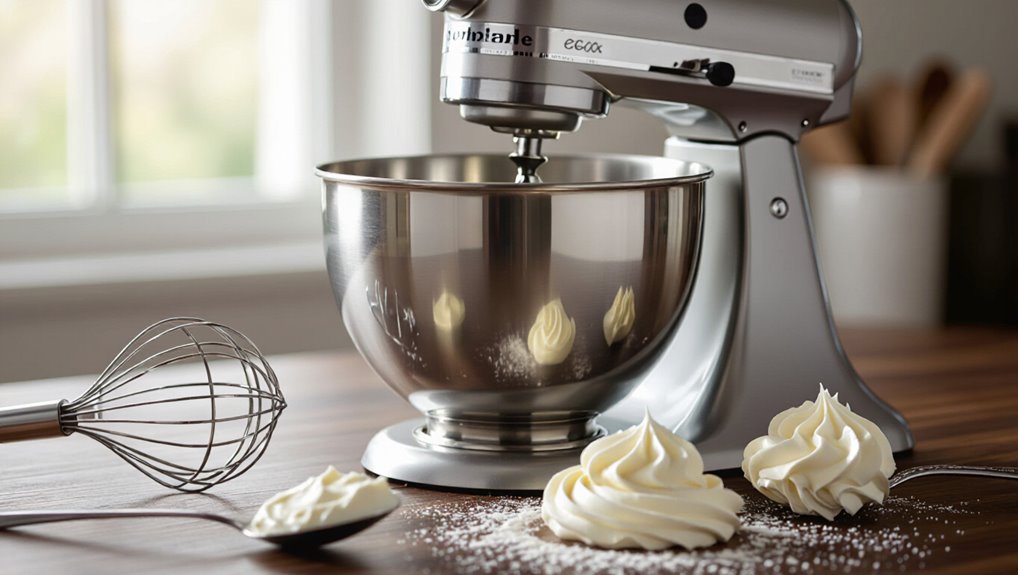
You’ll want to pay attention to air incorporation because whipped volume directly affects how much buttercream you get and how it pipes.
The amount of air you beat in also changes texture — from light and fluffy to dense and satin-smooth.
Finally, that same air balance influences stability, so some buttercreams hold shape better while others need refrigeration or extra stabilizers.
Whipped Volume Importance
Whipped volume determines texture, stability, and how a buttercream holds piping details, so choosing the right attachment matters.
You’ll control air to match the recipe’s needs:
- Light buttercreams — use the whisk to maximize lift.
- Classic American — paddle gives moderate air and smoothness.
- Stiffer fondant-style — beaters add density with minimal aeration.
Adjust speed and time to hit your target volume.
Texture And Stability
Anyone making buttercream needs to understand how air changes texture and stability, because the amount and size of incorporated bubbles decide whether your frosting will feel silky, fluffy, or collapse under its own weight.
You’ll choose attachments to control aeration: whisk for light, airy Swiss or Italian buttercreams; paddle for denser American-style frostings; slower beater speeds keep bubbles small, boosting stability for piping and layered cakes.
When to Use the Whisk
When you need lightness and volume in buttercream—think airy Swiss or Italian versions—the whisk is your go-to attachment.
When you want airy, voluminous buttercream—reach for the whisk to whip light, glossy meringue-based frostings.
You’ll whip in bubbles, incorporate air, and smooth meringue-based frostings quickly.
Use it for:
- Aerating egg-white or Italian/Swiss buttercream.
- Achieving fluffy, pipeable texture.
- Quickly dissolving sugar into a glossy, stable foam.
When to Use the Paddle
When you need to cream butter evenly without whipping in too much air, reach for the paddle.
Use it to fold in sugar gently so your buttercream stays smooth and stable. It’s the best choice when you want structure and want to prevent over-aeration.
Creaming Butter Evenly
The paddle attachment is your go-to for creaming butter because it uses broad, flat surfaces to whip air into softened butter and sugar without overworking them.
You’ll get even texture, consistent aeration, and smoothness by using moderate speed.
Use these tips:
- Start with room-temperature butter.
- Scrape bowl sides periodically.
- Stop when light and fluffy, not greasy.
Folding In Sugar
1 simple rule: use the paddle to fold in sugar once your butter is light and fluffy, and you want to incorporate granulated or powdered sugar without deflating the aeration you’ve built. You’ll add sugar gradually, scrape bowl, and mix on low until just combined to preserve texture.
| Step | Action |
|---|---|
| 1 | Add sugar gradually |
| 2 | Low speed mixing |
| 3 | Scrape sides |
| 4 | Stop when combined |
Preventing Over-Aeration
If you want a silky, stable buttercream without extra air bubbles, reach for the paddle attachment once your butter’s pale and fluffy and you start adding sugar — it lets you combine ingredients gently so you don’t whip in more air than needed.
- Stop mixing as soon as sugar’s incorporated.
- Use low speed to maintain density.
- Scrape bowl and fold briefly by hand to finish.
When to Use the Beater
When you’re making American or simple buttercream, reach for the flat beater: it creams butter and sugar quickly and evenly without overworking the mixture.
Use it for smooth, sturdy frostings, chocolate or flavored buttercreams, and when you want a dense, pipeable texture.
Stop mixing as soon as ingredients are homogenous to avoid melting or separating; scrape bowl edges once or twice.
Whisk Effects: Achieving Cloud-Like Volume
Although the whisk’s job looks simple, it transforms buttercream into airy, cloud-like frosting by incorporating tiny air bubbles and whipping them to stable volume. You’ll use it for Swiss or Italian buttercreams and for any recipe that calls for a lighter, silkier finish.
Although simple, the whisk turns buttercream into airy, cloud-like frosting—perfect for silkier Swiss or Italian finishes.
Use it wisely:
- Start slow, increase speed to avoid splatter.
- Watch texture—soft peaks mean airy yet stable.
- Stop when glossy to prevent overwhipping.
Paddle Effects: Building Body Without Overwhipping
When you switch to the paddle, you’ll get even texture development without whipping in a ton of air.
It lets you control how much cream you fold in so the buttercream stays smooth and stable.
Use slower speeds to prevent air overload while still building body.
Even Texture Development
Because the paddle gently folds air and incorporates fat, it helps you build a smooth, stable buttercream without overwhipping.
You’ll get even texture by controlling speed, time, and ingredient temperature.
Try these steps:
- Start slow, increase to medium for uniform blending.
- Scrape bowl once to guarantee no pockets.
- Stop when mixture looks cohesive and satin-smooth.
Cream Incorporation Control
If you want a buttercream that’s airy yet stable, the paddle gives you precise control over cream incorporation so you build body without overwhipping; its wide, flat surface folds and presses the mixture, evenly distributing butter and sugar while limiting excess air. You’ll judge texture by feel and adjust speed to refine structure.
| Action | Result |
|---|---|
| Fold | Gentle body |
| Press | Even blend |
| Short mix | Stable cream |
| Low speed | Controlled air |
Preventing Air Overload
Though you want a light, velvety buttercream, you’ll beat in too much air if you let the paddle run on high—so use it to build body gradually by working at low to medium speeds and watching texture, not time.
- Stop and scrape to assess density.
- Reduce speed at first signs of frothiness.
- Chill briefly if it puffs, then resume gently.
Beater Effects: Fast Mixing With Controlled Aeration
Beaters deliver rapid, even mixing while keeping aeration in check, so you get smooth buttercream without a foamy texture.
You’ll work at medium speed, folding ingredients efficiently and preventing large air pockets. This attachment blends sugar and butter uniformly, shortens mixing time, and helps maintain a dense, spreadable consistency.
You can stop and scrape often for flawless integration.
Attachment Impact on American Buttercream
When you switch attachments, you’ll notice the whip changes how quickly air gets incorporated into American buttercream.
That speed affects both the frosting’s texture—light and fluffy versus dense—and its stability for piping or holding shape.
Pick the attachment that balances the incorporation speed you want with the texture and stability your project needs.
Whip Incorporation Speed
Because the attachment determines how air gets folded into your buttercream, whip speed changes both texture and time-to-finish: the whisk tosses in air fast for a light, fluffy American buttercream, while paddle attachments work slower and yield a denser, creamier result.
- Whisk: high speed, rapid volume increase.
- Paddle: medium speed, controlled incorporation.
- Beater: low speed, minimal aeration for quick, stable mixing.
Texture And Stability
Now that you’ve seen how whip speed changes aeration, consider how each attachment shapes the final mouthfeel and hold of American buttercream.
The whisk yields light, airy texture but softer peaks that can slump in heat.
The paddle creates denser, creamier buttercream with stable structure for piping.
The flat beater gives balanced consistency—moderate aeration and reliable stability for most decorating needs.
Attachment Impact on Swiss and Italian Meringue Buttercreams
Although Swiss and Italian meringue buttercreams both rely on whipped egg whites and sugar, the mixer attachment you choose directly affects how quickly you reach stable, glossy peaks and how much air gets incorporated.
Use attachments like this:
- Whisk: fastest, maximum volume.
- Paddle: gentler, denser texture.
- Beater: slow, uneven aeration.
Choose based on desired lightness and stability.
Attachment Impact on Swiss-Style Silky Frostings
When you want a silky, Swiss-style frosting that’s smooth without excess air, the mixer attachment you pick controls both texture and sheen—use a whisk for rapid aeration and lighter loft, a paddle for a satiny, slightly denser finish, and reserve a low-speed beater only if you need minimal incorporation.
| Attachment | Result |
|---|---|
| Whisk | Light, airy |
| Paddle | Silky, dense |
Best Attachment for Buttercream Piping
Having chosen the paddle for a satiny Swiss-style finish or the whisk for extra lift, you’ll pick a different attachment when your goal is neat, consistent piping—usually the paddle or a flat beater at low speed gives the control and stability you need.
- Paddle: smooth, stable flow for detailed tips.
- Flat beater: firmer base, less air for crisp edges.
- Whisk (rare): only for airy, delicate rosettes.
Best Attachment for Buttercream Spreading Texture
When you’re aiming for a silky finish, the attachment you pick affects smoothness and how much air gets whipped into the buttercream.
You want something that creates a spreadable texture without over-aerating, so the frosting stays stable on the cake.
Let’s compare which attachments give the best balance of spreadability and hold.
Smoothness And Air Incorporation
Texture matters: you want buttercream that’s silky and airy, not dense or grainy, so choose the attachment that whips in just the right amount of air while smoothing out lumps.
- Whisk: aerates quickly for lightness.
- Paddle: balances air and smoothing for even texture.
- Beater: less aeration, good if you want denser, controlled results.
Spreadability And Stability
Because you’ll be spreading the buttercream over cakes and piping details, you want an attachment that creates a smooth, pliable consistency that holds shape without dragging—typically the paddle or flat beater.
You’ll get even texture and predictable stability, so buttercream spreads cleanly and pipes crisply.
Avoid the whisk for heavy work; it’s too airy. Use paddle for control and resilience.
Best Attachment for Buttercream Filling Stability
Although you might prioritize speed or volume, stability is the trait that keeps buttercream fillings from weeping or collapsing between layers. Your choice of mixer attachment plays a big role.
Stability matters more than speed or volume—choose your mixer attachment to keep buttercream fillings from weeping or collapsing.
Use attachments to control texture and air. Choose wisely:
- Paddle — gives dense, stable structure for fillings.
- Whisk — adds air, less stable for stacked fillings.
- Beater — balanced option for moderate stability.
Mixing Time Benchmarks by Attachment
When you adjust mixing times by attachment, small changes make big differences in consistency and stability; use the paddle for shorter, firmer mixes, the whisk for quick aeration, and the beater when you want a middle ground.
Aim for 2–3 minutes on paddle at medium speed, 4–6 minutes with the whisk for lightness, and 3–4 minutes with the beater, checking texture as you go.
Signs of Undermixed Buttercream by Attachment
Watch for a grainy, sandy texture when you taste or spread the frosting—that’s a clear sign it hasn’t emulsified properly.
If your buttercream looks deflated or has lost volume after whipping, you likely stopped mixing too soon.
Different attachments hide these issues differently, so you’ll want to adjust mixing times accordingly.
Visible Grainy Texture
If your buttercream looks grainy instead of smooth, it usually means it hasn’t been mixed long enough or the attachment isn’t cutting the butter into tiny, uniform particles.
- Whisk: can aerate but may leave flecks if butter is too cold.
- Paddle: generally smooths faster; stop and scrape to finish.
- Beater: slower; increase speed or soften butter slightly to eliminate graininess.
Collapsed Volume
Graininess often signals under-mixed butter particles, and another clear sign is collapsed volume—your buttercream looks deflated, glossy, and won’t hold peaks.
If you use the whisk, it likely didn’t aerate enough; the paddle may have failed to incorporate air due to low speed; the beater can compress rather than lighten.
Increase mixing time, scrape bowl, and adjust speed to restore loft.
Signs of Overmixed Buttercream by Attachment
When you’ve whipped buttercream too long, each attachment leaves distinct clues you can spot quickly:
- Whisk: airy peaks deflate, texture turns grainy and slightly curdled.
- Paddle: buttercream looks dense, glossy streaks appear, and it clumps.
- Beater: mixture separates; you’ll see thin, oily liquid pooling while solids look lumpy and heavy.
How to Rescue Broken or Separated Buttercream With Each Attachment
You’ve already learned how each attachment signals overmixing, so you can spot trouble fast and act before it gets worse.
If buttercream splits with the whisk, slow mixer, add chilled butter cubes and whip gently.
With the paddle, stop, scrape bowl, and beat at low speed to reincorporate.
For the beater, warm bowl slightly and mix briefly until smooth.
Adjust Sugar & Liquid for Each Attachment
Different attachments can change how sweet and thin your buttercream feels, so you’ll want to tweak sugar amounts accordingly.
If your paddle or whisk aerates the mix more, try cutting a tablespoon or two of sugar to keep the texture from getting grainy or overly stiff.
Likewise, adjust liquid—add a splash more milk or cream with denser beaters, and reduce it when the whisk makes the frosting too loose.
Adjusting Sugar Amounts
Because each mixer attachment handles aeration and emulsification differently, you’ll want to tweak both sugar and liquid to get the right buttercream texture.
Adjust sugar amounts based on aeration: mix less if airy, more if dense.
Simple guide:
- Whisk: reduce sugar slightly to avoid overly fluffy sweetness.
- Paddle: use standard sugar for balanced body.
- Beater: add a bit more sugar for structure and stability.
Modifying Liquid Volume
While adjusting sugar helps with sweetness and structure, you’ll also need to tweak liquid so each attachment produces the right buttercream consistency. Whisks trap air and thin the mix, so cut liquids slightly. Paddles work well with baseline liquid, and beaters may need a touch more to loosen a firm, less-aerated batter.
Taste and texture guide you: add milk or cream a teaspoon at a time, or reduce if it feels runny.
How to Scale Recipes and Maintain Texture Across Attachments
When you scale a buttercream recipe up or down, you’ll need to adjust not just ingredient quantities but mixing time and speed to keep the texture consistent across paddle, whisk, or paddle-with-scraper attachments.
Follow these quick steps to preserve structure:
Follow these quick steps to preserve structure: adjust mixing time, choose the right attachment, then taste and test.
- Increase mixing time moderately for larger batches; shorten for small ones.
- Match attachment to incorporate rate (whisk = aeration, paddle = creaminess).
- Taste and test consistency before decorating.
Practical Tips for Starting Speed and Speed Changes
If you’re starting a buttercream batch, begin on low to combine ingredients without splattering, then ramp up gradually as the mixture comes together—short bursts to medium speed for creaming and a steady medium-high for final aeration; adjust based on attachment (paddle = slightly faster for smoothness, whisk = slower increases to avoid over-aeration) and stop to scrape the bowl if you see unmixed pockets.
| Action | Tip |
|---|---|
| Start | Low for 15–30s |
| Ramp | Short bursts to medium |
| Final | Medium-high steady |
| Scrape | As needed between speeds |
Attachment and Bowl Materials: Stainless vs Silicone vs Nylon
You’ll notice stainless steel attachments and bowls are built to last and resist staining or warping.
Silicone and nylon can be gentler on nonstick bowls and scrape better, but they may wear faster or retain oils.
Consider durability versus performance when choosing the right material for buttercream.
Stainless Steel Durability
Durability matters a lot when you’re choosing between stainless steel, silicone, and nylon attachments and bowls, because each material wears differently under heavy use.
Stainless steel resists scratches, won’t absorb odors, and handles high speeds. Consider:
- Lifespan: long-lasting with proper care.
- Maintenance: dishwasher-safe and nonporous.
- Strength: holds shape under heavy buttercream batches.
Silicone And Nylon Performance
While stainless steel holds up under heavy use, silicone and nylon bring different strengths you should weigh when making buttercream.
Silicone scrapers stay flexible, scrape bowls clean, and resist heat, preventing overmixing hot fillings.
Nylon attachments are gentler on nonstick bowls and reduce noise, but they can retain grease and stain.
Choose based on bowl material, cleaning preferences, and durability needs.
Hand Versus Stand Mixing: When Attachments Still Matter
If you reach for a hand mixer because it’s quicker or easier to handle, don’t assume attachments don’t matter—choice of beaters and paddles still shapes texture and ease.
You’ll notice differences in aeration, speed, and cleanup:
- Whisks: add air quickly, lighter buttercream.
- Paddle-like beaters: give denser, smoother results.
- Flat beaters: reduce splatter, ease folding.
When to Swap Paddle and Beater
When your buttercream starts silky and soft or becomes too airy, swap the paddle for the beater to regain control and texture. Watch consistency: if it’s loose, use paddle; if too fluffy, switch to beater briefly. Taste and feel guide you. Stop when density and sheen match your recipe.
| Signal | Action |
|---|---|
| Loose | Paddle |
| Too airy | Beater |
| Grainy | Paddle |
| Overwhipped | Beater |
Common Mistakes Bakers Make When Choosing Attachments
Because you mightn’t realize how much attachment choice affects texture, bakers often grab whatever fits and wonder why the buttercream fails, curdles, or becomes overly airy.
You should avoid these mistakes:
- Using the whisk for heavy creaming — it over-incorporates air.
- Relying on the paddle for meringue-like textures.
- Switching attachments mid-batch without stopping and scraping.
Recipe Tweaks for Ultra-Smooth Swiss-Style Frosting
Although Swiss-style frosting seems fussy, small tweaks make it reliably ultra-smooth: strain your cooked egg-sugar mixture, cool it to just-warm before whipping, and use the paddle at medium speed to fold in soft butter gradually so the emulsion stays stable. Keep ingredients room temperature, add butter bit by bit, and stop whipping once glossy and spreadable.
| Step | Temp | Action |
|---|---|---|
| 1 | warm | whip egg-sugar |
| 2 | just-warm | fold butter |
| 3 | room | finish glossy |
Recipe Tweaks for Ultra-Fluffy American Buttercream
For ultra-fluffy American buttercream, focus on aeration, balance, and timing:
- Whip room-temp butter until pale and airy, 3–5 minutes.
- Add powdered sugar gradually, beating between additions to trap air.
- Use a few tablespoons of milk or cream and a pinch of salt to adjust texture and taste; don’t overbeat once fluffy to avoid collapse.
Best Attachment for Flavored or High-Contrast Add-Ins
Now that you’ve mastered aeration and timing for ultra-fluffy American buttercream, think about which stand mixer attachment will best incorporate bold or chunky add-ins without deflating your frosting.
Use the paddle on low to fold in zests, cocoa nibs, or chopped nuts gently.
For thin flavorings or swirls, finish by hand-folding to preserve texture and contrast without overmixing.
Cleaning and Care Tips That Preserve Attachment Performance
When you rinse and wipe attachments right after use, you’ll prevent hardened icing and corrosion that make them work harder and wear faster.
Clean promptly, dry thoroughly, and store properly to keep performance sharp.
Clean and dry attachments right away, then store them properly to keep performance sharp.
- Wash with warm soapy water; avoid abrasive pads.
- Dry immediately and air briefly to prevent rust.
- Inspect and tighten connections before next use.
Recommended Attachments for Popular Stand Mixer Models
Many popular stand mixers come with or support a few go-to attachments that make buttercream mixing effortless: a flat beater for standard American buttercreams, a paddle with silicone edge for scraping bowl sides, and a whisk or flex whisk for ultra-light Swiss or Italian styles. You’ll choose based on model compatibility and recipe: match attachment, speed, and bowl size.
| Brand | Recommended | Note |
|---|---|---|
| KitchenAid | Paddle | Universal fit |
| Bosch | Whisk | High power |
| Ankarsrum | Beater | Large bowl |
Test Checklist: Evaluate Your Buttercream Outcome After Mixing
Start by checking four key qualities: texture, shine, stability, and taste.
Then evaluate immediately using these quick tests:
- Spoon test: should glide smoothly, no graininess.
- Peak test: hold a soft peak without collapsing.
- Taste test: balance of sweetness and butter, no greasy aftertaste.
Record results and adjust mixing time or attachment choice accordingly.
Further Reading and Recipe Experiments to Try With Each Attachment
Because different attachments change texture and aeration, you’ll want targeted recipes and reading to explore their strengths—try Swiss meringue buttercream with the whisk for lightness, American buttercream with the paddle for a dense, spreadable finish, and a paddle-whisk hybrid technique for stabilized fillings.
Explore recipe sources on technique, speed, and timing; experiment with ratios, chill times, and flavor infusions to master each result.
Frequently Asked Questions
Can Attachments Affect Buttercream Shelf Life or Refrigeration Needs?
Yes — attachments can affect texture, which influences perceived stability; overbeating with a whisk traps air, shortening shelf life, while paddle gives denser buttercream that chills better. You’ll still store by ingredients and refrigeration needs.
Do Attachments Influence Crust Formation on Frosted Cakes?
Yes — the attachment you use can influence crust formation: you’ll whip more air with a whisk, creating a fluffier, slower-crusting frosting, while a paddle/beater yields denser buttercream that forms a firmer, quicker crust on the cake.
Which Attachment Is Best for Coloring Buttercream Evenly?
Use the paddle attachment; it mixes coloring evenly into buttercream without whipping in excess air. You’ll scrape the bowl, mix on low to medium, and add dye gradually so color disperses uniformly for smooth, consistent shades.
Can Attachment Choice Change Buttercream Allergy or Vegan Substitutions?
No — attachment choice won’t change buttercream’s allergy or vegan status. You’ll need to swap ingredients (use vegan butter, aquafaba, or shortening) and avoid cross‑contact; the mixer tool only affects texture, not dietary properties.
Do Different Attachments Impact Buttercream Freezing and Thawing Quality?
Yes — different attachments can affect freezing and thawing. You’ll get smoother, aerated buttercream with a whisk, denser results with a paddle, and variable texture with a beater, which influences ice crystal formation and recovery.
Conclusion
You’ve got the know-how to choose the right attachment for the buttercream you want—whisk for airiness, paddle for smoothness, and beater for quick, sturdy mixes. Match attachment, speed, and recipe goals, watch texture as you go, and stop when you hit the right consistency. Clean and care for attachments to keep performance consistent, and try the suggested tests and experiments to refine your technique. Enjoy better, more predictable buttercream every time.


